To comply with a CAPA mandate, a large biotechnology company needed to unify sample data across closed and ongoing studies. Data was fragmented across 24+ vendors with no centralized oversight, driving gaps, inconsistencies, and rising operational risk.
The Solution
QuartzBio’s Sample Intelligence Solution was deployed as a unified data foundation with automated ingestion pipelines across all 24 vendors. AI-driven workflows enabled real-time harmonization, monitoring, and gap detection over a centralized, findable data asset.
The Outcomes
The CAPA was resolved by delivering a cross- functional single source of truth spanning 1M+ samples, with proactive detection of data gaps and vendor inconsistencies. The result was major cost avoidance (~$1M manual, >$5M regulatory) and a future-ready, automated data ecosystem.
https://quartz.bio/wp-content/uploads/2026/05/2026-QB-Logo_New-Brand-Update_QB-DK-Blue.png00Chandreyee Dashttps://quartz.bio/wp-content/uploads/2026/05/2026-QB-Logo_New-Brand-Update_QB-DK-Blue.pngChandreyee Das2026-09-04 11:07:022026-09-04 11:07:02Managing 1M+ samples with one unified, compliant platform
A Top 5 global pharmaceutical company managing more than 100 concurrent clinical trials came to QuartzBio seeking to increase their R&D pipeline capacity without having to add headcount. They needed to move faster, operate smarter, and scale rapidly, all while keeping compliance and data quality intact.
This case study follows their journey from fragmented, manual sample operations to a fully connected, AI-powered workflow. The study showed that automation and unified sample intelligence can deliver both immediate operational improvements and long‑term portfolio and team scalability across complex global clinical programs.
The Challenges
Managing biospecimens across dozens of global clinical programs posed operationally challenging, and the client’s sample operations teams were stretched thin. The tools and systems they were using were not keeping pace with their needs.
Three core pain points stood out:
Fragmented systems: Paper logs, spreadsheets, and disconnected platforms created silos that made it difficult to get a clear, unified view of sample data.
Time‑consuming manual workflows: Routine tasks like copy-pasting files, consolidating informed consent data, and reconciling records across systems consumed hours that could have been spent on higher-value work.
Lack of sample lifecycle visibility: Teams had no reliable way to track sample counts, flag missing samples, project upcoming collections, or confirm consent completeness.
The path forward required two things: (1) unified, harmonized data that all stakeholders could access, and (2) a measurable reduction in the manual effort required to keep that data current.
The Solution: QuartzBio’s Sample Intelligence Solution
The solution combines deep domain expertise in data management and sample lifecycles with compliant (21 CFR Part 11, GxP / ICH E6 (R3), GDPR, HIPAA) business intelligence. The secure, interoperable platform provides automated data ingestion, harmonization, query tracking, sample lifecycle monitoring, consent tracking, and real‑time analytics powered by AI agents to unify, monitor, and maintain high‑quality biospecimen data across studies and vendors.
Throughout the case study period, the Sample Intelligence solution delivered broad impact across four client use cases:
Use Case 1: 360° Sample Visibility
A harmonized Master Sample Inventory integrating lab, EDC, and consent data.
Full visibility into shipped, analyzed, missing, or stable/unstable samples.
Use Case 2: Sample Data Quality
Automated detection of discrepancies across files.
Automated query tracking, resolution insights, and root‑cause visibility.
Identification of previously unknown data issues, improving data integrity.
Use Case 3: Sample Collection Monitoring & Compliance
Identification of samples not collected and visibility into expected vs. collected counts.
Projections of upcoming sample collections.
Support for ICH E6(R3) through timely detection of compliance risks.
Use Case 4: Sample Logistics & Testing Monitoring
Real‑time tracking of sample status, location, and chain of custody.
Monitoring of sample stability, duplicate testing, shipments, and testing status.
Outcomes
The teams achieved dramatic efficiency improvements, including:
85% reduction in time spent on sample‑related tasks (Table 1)
100% detection rate for missing samples and automated query generation.
Significant reductions in data ingestion, reconciliation, consent tracking, and Excel®‑based processes.
Task
Time Required Without QuartzBio
Time Required With QuartzBio
Impact
Data ingestion & file creation
527 min
24 min
82% faster
Sample collection monitoring
120 min
2 min
98% faster • 100% missing sample detection
Query tracking automation
120 min
10 min
92% faster • 100% automated query generation
Manual Excel® manipulation
143 min
8 min
87% faster
Consent tracking completeness
40 min
5 min
88% faster • 100% consent documentation
Data reconciliation
120 min
3 min
98% faster
Table 1. Automated tasks accelerated sample management. Sample operations tasks were completed an average of 85% faster, with some tasks up to 98% faster.
Capacity Expansion*
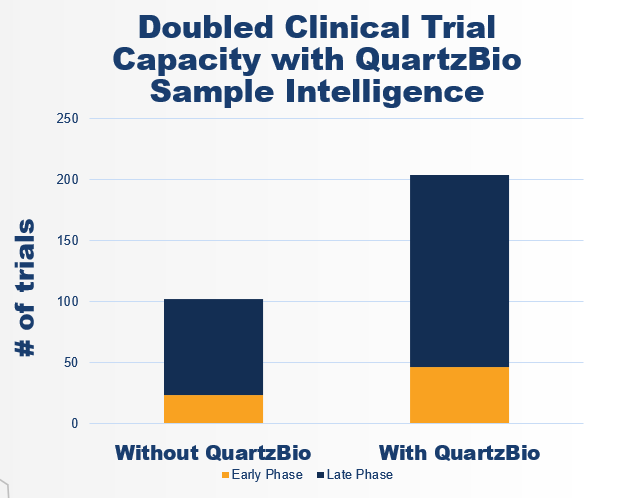
Because teams were spending dramatically less time on routine tasks, they could take on significantly more work — without adding headcount. Study capacity doubled across both early-phase (Phase I) and late-phase (Phase II/III) trials, representing an increase of 100+ trials managed by the same team (Figure 1).
Figure 1. Increased capacity: By implementing QuartzBio, the client increased their study capacity by 100+ trials without adding headcount.
Financial Impact**
The efficiency gains translated directly into cost savings. Using a fully loaded FTE cost of $250,000 (as cited by the client) and the observed 85% reduction in sample data management effort, the savings per study ranged from $196K to $283K, with a reliable planning midpoint of approximately $239K per study.
Scaled across a portfolio of 100+ trials, that represents the potential for hundreds of millions of dollars in efficiency gains — without compromising quality or compliance.
Qualitative Outcomes
Improved data quality, completeness, and timeliness of monitoring.
Earlier detection of issues that previously went unnoticed, reducing the risk of patient data loss
Strong cross-functional adoption, with 100% of users recommending the platform for continued use
In Their Words
At the close of the case study period, 100% of users reported that they would recommend the QuartzBio platform and Sample Intelligence solution. Here are a few of their comments:
“I was able to reduce manual reconciliation efforts and follow-up communications related to sample status and discrepancies.”
“Sample Intelligence (SI) was able to identify a pattern of data discrepancy– which identified a potential issue with our requisition form. That demonstrates the purpose of SI for our organization. No one had raised this as an issue previously–SI allowed us to identify this issue. This allowed us to fix a problem we wouldn’t have ever known about.”
Methodology
*Methodology used to calculate increased sample operations capacity:
Users reported the time required to complete key sample operations tasks before QuartzBio’s solution was implemented and again after implementation to quantify time savings. We then incorporated the proportion of a typical sample operations role dedicated to these tasks to determine realistic FTE impact. Finally, these reductions were applied across the existing trial portfolio to estimate the overall increase in capacity that the solution enabled.
**Methodology used to calculate financial impact:
We quantified the per-study financial impact of an 85% efficiency gain applied to sample data workflows. Using the typical team FTE range of 0.90 to 1.30 FTE, the reduction yields 0.765 to 1.105 FTE saved per study. When applying the fully loaded cost of $250,000 per FTE as cited by the client, the resulting savings ranged from $191,250 to $276,250 annually. The midpoint of this range—approximately $233,750—serves as a reliable single-value estimate for planning and forecasting.
Looking Ahead
This case study demonstrates that when sample data is unified, automated, and accessible in real time, teams can achieve 85% faster task completion, 100% missing sample detection, doubled study capacity, and more.
These savings emerge from reductions in manual reconciliations, vendor follow-up, data processing, sample inventory review, and cross-functional coordination. When scaled across multiple studies, this can create multi-million-dollar portfolio efficiencies, strengthen operational agility, reduce burnout risk, and enhance timelines for data-driven decisions.
Future case studies may explore additional downstream benefits, including reductions in manual errors, improved cross-functional collaboration, and faster overall R&D cycle times.
Learn how Sample Intelligence could amplify work for your team.
A 2025 TransCelerate + Tufts analysis across 105 Phase II/III protocols shows ~⅓ of procedures are non‑core—still work that sites/ops must manage—further inflating workload.
Syntheses from ICON and CRIO echo Tufts’ numbers (more procedures, sites, endpoints; more amendments), linking rising complexity to greater operational effort.
Operational footprint expands with study size (sites, recruitment, duration).
Nature’s analysis of 2,140 Phase III trials shows how large Phase III programs extend across more sites and recruit at slower per‑site rates—hallmarks of higher coordination and data/biomarker ops effort than earlier phases.
Roles that touch sample data are cross‑functional and scale with complexity.
EMA’s GCP Inspectors’ Reflection Paper on labs analyzing clinical‑trial samples details required controls around labeling, receipt, storage, chain of custody, validation, and data/IT—work that expands with sample throughput and vendor networks typical of later phases. [ema.europa.eu]
UKCRC guidance for Clinical Trial Units (CTUs) reinforces oversight and documentation expectations for labs and sample workflows under GCP—again indicating more moving parts = more effort.
Biospecimen management best practices formalize the non‑negotiable work (independent of ‘analytics’).
NCI Best Practices for biospecimens and ISBER Best Practices for biorepositories enumerate the end‑to‑end activities—collection, processing, shipping, storage, tracking, QA/QC, data management—required to keep sample integrity and traceability; as counts/timepoints/vendors increase by phase, so do these activities.
Workload/acuity models from the field validate the need to budget FTE by complexity, not just headcount.
ACRP’s peer‑reviewed article argues for complexity‑adjusted productivity models (beyond ‘patients per coordinator’)—the same rationale used to frame phase‑based FTE bands. [acrpnet.org]
SWOG (NCI network) and Mayo Clinic posters show practical workload sizing and CRC effort tools—evidence that programs estimate effort as protocol/site/sample complexity rises.
Analysis of screening, treatment and follow-up expenses, biological treatment per-patient costs can exceed $100,000.
Average per‑patient costs across phases: – Phase I average: $136,783 per patient – Phase I/II average: $155,340 per patient Source: ProRelix Research – “Phase-by-Phase Clinical Trial Costs Guide,” May 5, 2025.
Rare disease trial complexity and elevated operational costs: – Higher burdens due to limited patient pools, complex regimens, and recruitment challenges. Source: Rare Revolution Magazine – “Understanding the true cost of clinical trials,” August 4, 2025.
https://quartz.bio/wp-content/uploads/2026/05/2026-QB-Logo_New-Brand-Update_QB-DK-Blue.png00Chandreyee Dashttps://quartz.bio/wp-content/uploads/2026/05/2026-QB-Logo_New-Brand-Update_QB-DK-Blue.pngChandreyee Das2026-04-08 16:23:402026-08-27 16:11:05How a Top 5 Pharma Doubled Clinical Trial Capacity of Existing Teams
The challenge: sample management and inherent data issues
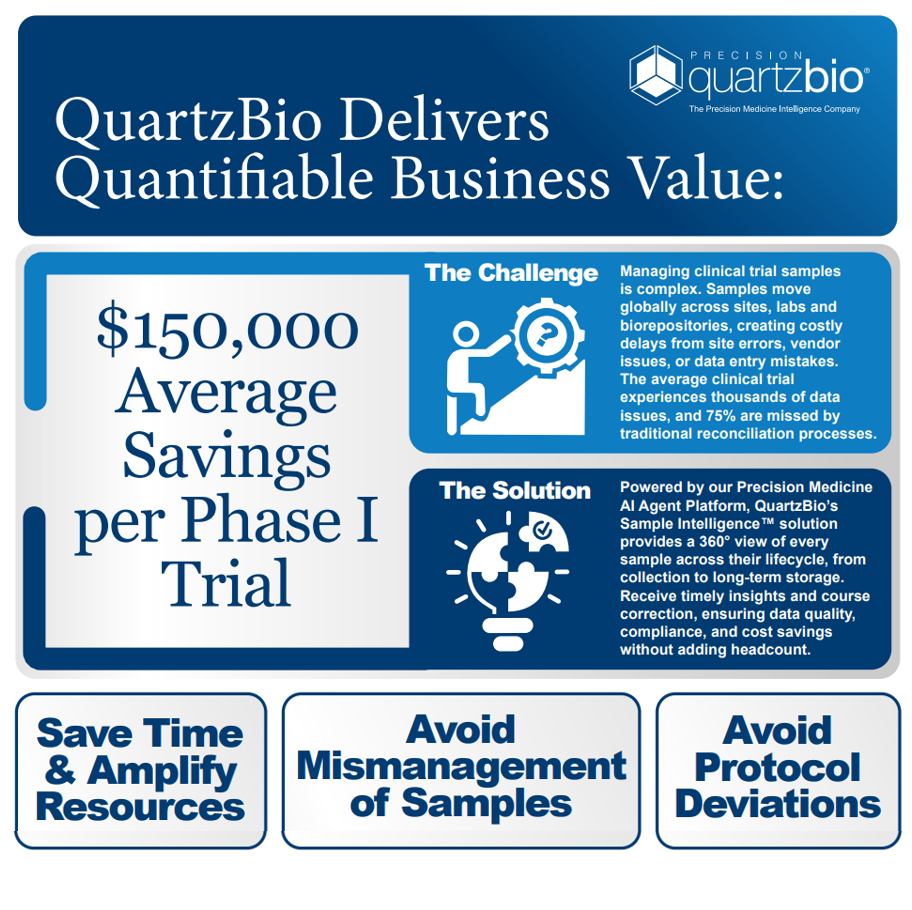
Managing clinical trial samples is complex. Samples move globally across sites, labs and biorepositories, creating costly delays from site errors, vendor issues, or data entry mistakes. Our customers were experiencing thousands of data issues per clinical trial, on average, and 75% were being missed by traditional reconciliation processes.
The solution: 360° Sample Intelligence
Powered by our Precision Medicine AI Agent Platform, QuartzBio’s Sample Intelligence™ solution provided a 360° view of every sample across their lifecycle, from collection to long-term storage. Our biomarker operations and biospecimen operations users received timely insights and course correction, ensuring data quality, compliance, and cost savings without adding headcount.
With QuartzBio, our customers were able to:
Save Time & Amplify Resources
Increase productivity by 2x
Focus teams on high-impact tasks
Achieve 10x faster time to insights
Avoid Mismanagement of Samples
Reduce out-of-protocol collections by up to 100%
Eliminate duplicate sample testing / sample waste
Improve collaboration
Avoid Protocol Deviations
Drive ICH E6(R3) compliance and reduce overall compliance risk
Accelerate access to high-quality data
Reduce human error
Ready to save $150,000+ per trial?
QuartzBio delivers 10x faster insights, enabling quicker study closures and better data quality — with no added headcount required. Get a demo of our Sample Intelligence™ solution:
https://quartz.bio/wp-content/uploads/2025/11/QuartzBio-Business-Value-Case-Study.png910912Chandreyee Dashttps://quartz.bio/wp-content/uploads/2026/05/2026-QB-Logo_New-Brand-Update_QB-DK-Blue.pngChandreyee Das2025-11-26 14:36:092026-04-14 19:52:43QuartzBio delivers quantifiable business value: $150,000 average savings per phase I trial
The client: Clinical operations team at a mid-sized oncology biotechnology company.
The clinical operations teams at a mid-sized oncology biotechnology company approached QuartzBio as they sought ways to close sample information gaps that would appear during reconciliation.
Gaps in this process typically included the inability to report in a timely manner on:
Missed collections
Unexpected samples
The status of samples and derivatives as they move onto third-party testing labs
The challenge: The sponsor team lacked global visibility into their expected sample schedule across all collection sites. Too much time was spent on manual reconciliation, with delays of three months costing the client significant time and resources.
In their existing reconciliation process, clinical operations leaders were often frustrated in their attempts to maintain robust global visibility. Generating reports was a time-consuming process that involved complex spreadsheets manually linking key information from the EDC, central labs, testing labs, and biorepositories to illuminate critical information like discrepancies or missed collections.
Without global visibility, the client had trouble generating reports continuously throughout the life of a study. New data was often unavailable, vendor-specific nomenclature was frequently inconsistent, and data structures were sometimes incompatible. Consolidated insight across sample collection and processing status, consent status, and sample and derivative quality information was difficult to obtain.
The client’s clinical operations team worked with QuartzBio’s biospecimen operations experts and data engineers to deploy the Sample Intelligence solution and create a centralized, reliable source of sample information. This single solution closed the gaps that were hampering the reconciliation process.
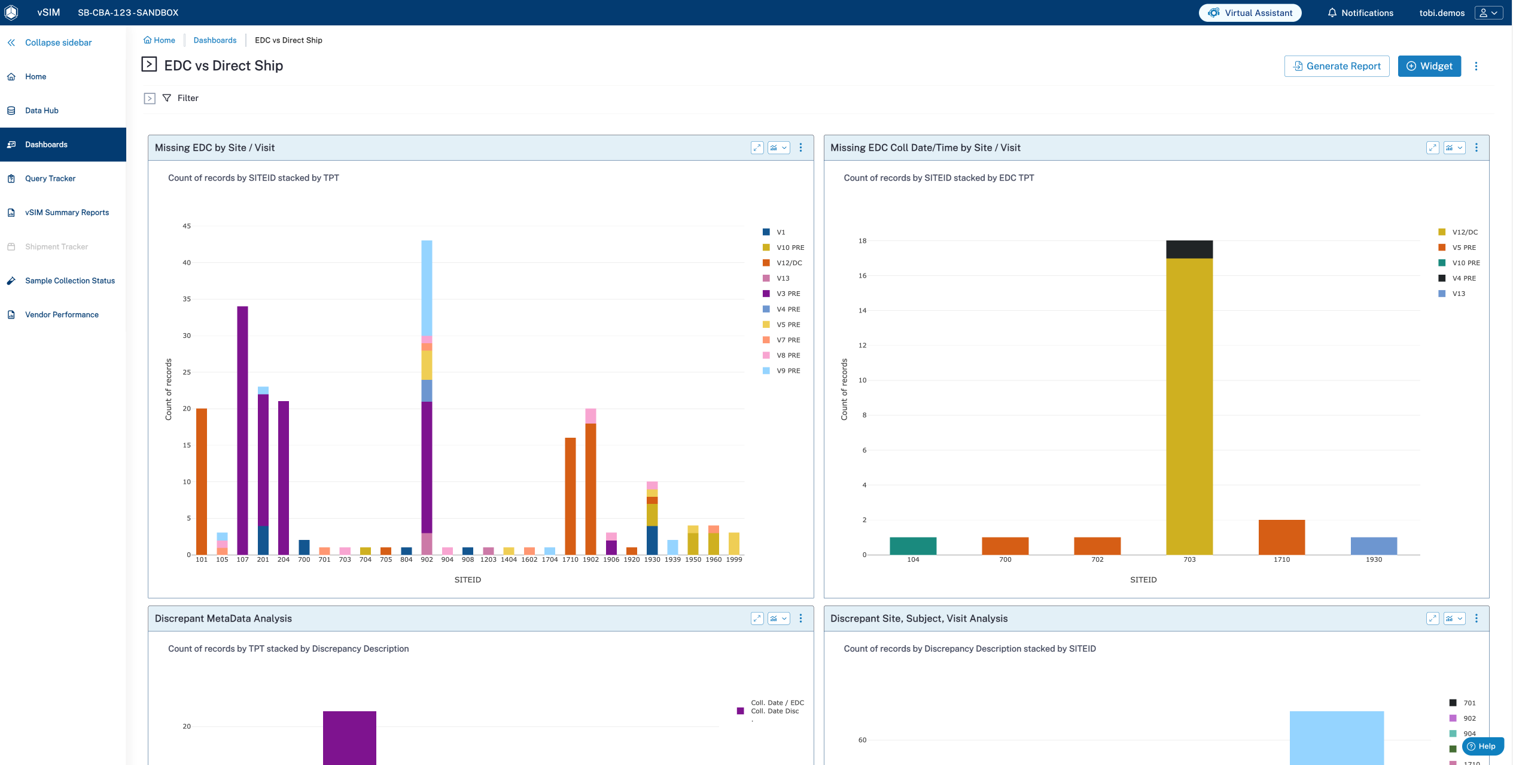
QuartzBio’s data ingestion and harmonization pipeline continuously integrated sample information from multiple sources. As this sample information was generated over the course of the study, the Sample Intelligence solution automatically performed edit checks and highlighted any data inconsistencies. For instance, teams could now see any direct reconciliation issues between the EDC and inventories at central labs, specialty labs, and biorepositories (Figure 1).
Figure 1. Automated sample reconciliation between EDC and other sample inventories enabled the clinical operations team to identify discrepancies between data that resides in any two source files (central lab vs. EDC, testing lab vs. EDC, and central lab vs. testing lab) and make timely corrections.
The outcome: Eliminating manual reconciliation processes with sponsor-centric visibility across the sample lifecycle
Reconciliation efforts typically have large gaps in sample information that is critical for sponsor teams to maintain robust global visibility across all collection sites. Clinical data management traditionally reconciles the EDC from other points of view (e.g., adverse events, concomitant medications, patient history, RECIST response evaluation, investigational product guideline (IP) compliance, and many others). The QuartzBio Sample Intelligence solution functioned as an additional tool pulling information together from the EDC, each lab, and each biorepository. The solution also incorporated the sample schedule from the protocol, including changes to the protocol as new patients were enrolled and the protocol was amended.
With reconciliation gaps reduced and closed, clinical operations teams now had sponsor-centric visibility into sample status across the lifecycle of collections, processing, testing, and storage. With a single day of delay in getting a new product to market costing $1-$8 million in sales (source), the benefits of more effective sample and biomarker operations providing a holistic view of samples on-study cannot be understated.
Learn more about implementing QuartzBio® solutions for your organization.
https://quartz.bio/wp-content/uploads/2023/05/Automated-Reconciliation-vs-EDC-QuartzBio-Highlight-1.png483672Chandreyee Dashttps://quartz.bio/wp-content/uploads/2026/05/2026-QB-Logo_New-Brand-Update_QB-DK-Blue.pngChandreyee Das2023-05-11 20:28:362026-08-14 15:48:14Closing sample data gaps during reconciliation